

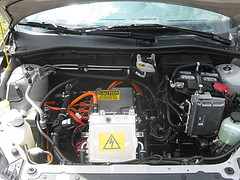
 A battery has been developed which could revolutionise electric car travel by extending battery life by 35 per cent. The battery manufacturers, Axeon, are now actively discussing plans to commercialise the technology.
Previous studies have cited ‘range anxiety’ as a major factor for people not choosing to go down the electric car route, with car manufacturers struggling to reduce battery size and weight. The newly developed device gives a range improvement of 35 per cent without increasing the device’s overall weight, however.
Following a £1.3 million pound project led by Axeon to prove NCM (Nickel Cobalt Manganese), electrochemistry could be used in real-world applications due to theoretical decreases in volume and mass. As a result, the new battery was developed.
During demonstrations, the device offered better weight distribution giving a better driver experience, also confirming an improvement in range and power.
In 2009 the Technology Strategy Board awarded a £680,000 grant which partially funded the research undertaken by Axeon, Allied Vehicles and Ricardo.
The technology could now be transplanted into a range of vehicles say Axeon and Allied Vehicles look set to be the first company to utilise the technology.
Managing Director of Allied Vehicles, Paul Nelson, expressed the company’s excitement at the benefits the innovation offers customers and the possibilities afforded by the new battery. He stated that they are actively seeking opportunities to use the technology in their vehicles.
The move followed last week’s news that standardised charging specifications had been agreed by car makers in Europe, making it possible for a range of electric vehicles to recharge in multiple countries from 2017.